
3 The Traditional Problem of Induction
3.1 introduction
In Chapter II we saw that inductive logi is used to shape our expectations of that which is as yet unknown on the basi of those facts that are already known; for instance, to shape our expectations o the future on the basis of our knowledge of the past and present. Our proble is the rational justification of the use of a system of scientific inductive logic rather than some other system of inductive logic, for this task.
The Scottish philosopher David Hume first raised this problem, which w shall call the traditional problem of induction, in full force. Hume gave th problem a cutting edge, for he advanced arguments designed to show that n such rational justification of inductive logic is possible, no matter what the details of a system of scientific inductive logic tum out to be.
3.2. HUME' S ARGUMENT
Presumably we could rationally justify such a system if we could show that it is well-suited for the uses to which it is put. One of the most important uses of inductive logic is in setting up our predictions of the future. Inductive logic figures in these predictions by way of epistemic probabilities. If a claim about the future has high epistemic probability, we predict that it will prove true. And, more generally, we expect something more or less strongly as its epistemic probability is higher or lower. The epistemic probability of a statement is just the inductive probability of the argument which embodies all available information in its premises.
Thus, the epistemic probability of a statement depends on two things: (i) the stock of knowledge, and (ii) the inductive logic used to grade the strength of the argument from that stock of knowledge to the conclusion
Can't use deducive argumets here so ...For this sort of daring behavior we will have to rely on inductively strong arguments-and we will have to give up the comfortable assurance that we will be right all the time.
How about most of the time? Let us call the sort of argument used to set up an epistemic probability an e-argument. That is, an e-argurnent is an argument which has, as its premises, some stock of knowledge. We might hope, then, that inductively strong e-arguments will give us true conclusions most of the time. Remember that there are degrees of inductive strength and that, on the basis of our present knowledge, we do not always simply predict or not-predict that an event will occur, but anticipate it with various degrees of confidence.
We might hope further that inductively stronger e-arguments have true conclusions more often than inductively weaker ones. Finally, since we think that it is useful to gather evidence to enlarge our stock of knowledge, we might hope that inductively strong e-arguments give us true conclusions more often when the stock of knowledge embodied in the premises is great than when it is small.
The last consideration really has to do with justifying epistemic probabilities as tools for prediction. The epistemic probability is the inductive probability of an argument embodying all our stock of knowledge in its premises. The requirement that it embody all our knowledge, and not just some part of it, is known as the Total Evidence Condition. If we could show that basing our predictions on more knowledge gives us better success ratios, we would have justified the total evidence condition.
We are now ready to suggest what is required to rationally justify a system of inductive logic:
Rational Justification Suggestion:
A system of inductive logic is rationally justified if and only if it is shown that the arguments to which it assigns high inductive probability yield true conclusions from true premises most of the time, and the e-arguments to which it assigns higher inductive probability yield true conclusions from true premises more often than the arguments to which it assigns lower inductive probability
It is this sense of rational justification, or something quite close to it, that Hume has in mind when he advances his arguments to prove that a rational justification of scientific induction is impossible.
If scientific induction is to be rationally justified in the sense of Suggestion above, we must establish that the arguments to which it assigns high inductive probability yield true conclusions from true premises most of the time. By what sort of reasoning, asks Hume, could we establish such a conclusion? the argument that we must use is to have any force whatsoever, it must be either deductively valid or inductively strong. Hume proceeds to show tha neither sort of argument could do the job.
Suppose we try to rationally justify scientific inductive logic by means of a deductively valid argument. The only premises we are entitled to use in thi argument are those that state things we know. Since we do not know what th future will be like (if we did, we would have no need of an inductive logic o which to base our predictions), the premises can contain knowledge of onl the past and present. But if the argument is deductively valid, then the conclu sion can make no factual claims that are not already made by the premises Thus, the conclusion of the argument can only refer to the past and present not to the future, for the premises made no factual claims about the future. Such a conclusion cannot, however, be adequate to rationally justify scientific induction.
To rationally justify scientific induction we must show that e-arguments t which it assigns high inductive probability yield true conclusions from true premises most of the time. And "most of the time" does not mean most of the time in only the past and present; it means most of the time, past, present, an future. It is conceivable that a certain type of argument might have given us true conclusions from true premises in the past and might cease to do so in the. future. Since our conclusion cannot tell us how successful arguments will be in the future, it cannot establish that the e-arguments to which scientific induction assigns high probability will give us true conclusions from true premises rrwst of the time. Thus, we cannot use a deductively valid argument to rationally justify induction.
Suppose we try to rationally justify scientific induction by means of an. inductively strong argument. We construct our argument, whatever it may be, and present it as an inductively strong argument. 'Why do you think that this is an inductively strong argument?" Hume might ask. "Because it has a high inductive probability," we would reply. "And what system of inductive logic assigns it a high probability?" "Scientific induction, of course." What Hume has pointed out is that if we attempt to rationally justify scientific induction by use of an inductively strong argument, we are in the position of having to assume that scientific induction is reliable in order to prove that scientific induction is reliable; we are reduced to begging the question. Thus, we cannot use an inductively strong argument to rationally justify scientific induction.
A common argument is that scientific induction is justified because it has een quite successful in the past. On reflection, however, we see that this argument is really an attempt to justify induction by means of an inductively strong argument, and thus begs the question.
We can view the traditional problem of induction from a different perspective by discussing it in terms of the principle of the uniformity of nature. Although we do not have the details of a system of scientific induction in hand, we do know that it must accord well with common sense and scientific practice, and we are reasonably familiar with both. A few examples will illustrate a general principle which appears to underlie both scientific and common-sense judgments of inductive strength.
Thus, it seems that underlying our judgments of inductive strength in both common sense and science is the pre' ! supposition that nature is uniform or, as it is sometimes put, that like causes produce like effects throughout all regions of space and time. Thus, we can say that a system of scientific induction will base its judgments of inductivly strength on the presupposition that nature is uniform (and in particular that the future will resemble the past).
This rough understanding is suffi- · cient for the purposes at hand. But we should bear in mind that the task of giving an exact definition of the principle, a definition of the sort that would be presupposed by a system of scientific inductive logic, is as difficult as the construction of such a system itself. One of the problems is that nature is simply not uniform in all respects, the future does not resemble the past in all respects. Bertrand Russell once speculated that the chicken on slaughter-da imight reason that whenever the humans came it had been fed, so when the humans would come today it would also be fed. The chicken thought that the future would resemble the past, but it was dead wrong.
The future may resemble the past, but it does not do so in all respects. And we do not know beforehand what those respects are nor to what degree the future resembles the past. Our ignorance of what these respects are is a deep, !reason behind the total evidence condition. Looking at more and more evidence helps us reject spurious patterns which we might otherwise project into the future. Trying to say exactly what about nature we believe is uniform:thus turns out to be a surprisingly delicate task.
But suppose that a subtle and sophisticated version of the principle of the #uniformity_of_nature can be formulated which adequately explains the judgments of inductive strength rendered by scientific inductive logic. Then if nature is indeed uniform in the required sense (past, present, and future), e-arguments judged strong by scientific induction will indeed give us true conclusions most of the time. Therefore, the problem of rationally justifying scientific induction could be reduced to the problem of establishing that nature is uniform.
But by what reasoning could we establish such a conclusion? If an flargument is to have any force whatsoever it must be either deductively valid or inductively strong. Seems like we are stuck.
3.2 THE INDUCTIVE JUSTIFICATION OF INDUCTION
The answer to the question "Why should we believe that scientific induction is a reliable guide for our expectations?" that immediately occurs to everyone is "Because it has worked well so far." Hume's objection to this answer was that it begs the question, that it assumes scientific induction is reliable in order to prove that scientific induction is reliable. The proponents of the inductive justification of induction, however, claim that the answer only appears to beg the question, because of a mistaken conception of scientific induction. They claim that if we properly distinguish levels of scientific induction, rather than lumping all arguments that scientific induction judges to be strong in one category, we will see that the inductive justification of induction does not beg the question. Just what then are these levels of scientific induction? And what is the relevance to the inductive justification of induction? We can distinguisg different levels of argument, in terms of the things they talk about. Arguments level 1 will talk about individual things or events; for instance:
**Many jub-jub birds have been observed, and they have all been purple.
The next jub-jub bird to be observed will be purple.**
Level 1 of scientific inductive logic would consist of rules for assigninii inductive probabilities to arguments of level 1. Presumably the rules of level 1 of scientific induction would assign high inductive probability to the preceeding argument. Arguments on level 2 will talk about arguments on level 1; for instance:
**Some deductively valid arguments on level 1 have true premises. All deductively valid arguments on level 1 which have true premises have true conclusions.
Some deductively valid arguments on level 1 have true conclusions**
This is a deductively valid argument on level 2 which talks about deductively valid arguments on level 1. The following is also an argument on level 2 whichft talks about arguments on level 1: **Some arguments on level 1 which the rules of level 1 of scientific inductive logic say are inductively strong have true premises. The denial of a true statement is a false statement.
Some arguments on level 1 which the rules of level 1 of scientific inductive logic say are inductively strong have premises whose denial is false .
This is a deductively valid argument on level 2 that talks about arguments on flevel 1, which the rules of level 1 of scientific inductive logic classify as inductively strong.
There are, of course, arguments on level 2 that are not deductively valid, band there is a corresponding second level of scientific inductive logic which lconsists of rules that assign degrees of inductive strength to these arguments;There are arguments on level 3 that talk about arguments on level 2, arguments on level 4 that talk about arguments on level 3, and so on. For each level of argument, scientific inductive logic has a corresponding level of rules. This characterization of the levels of argument, and the corresponding. levels of scientific induction, is summarized in Table III. I.
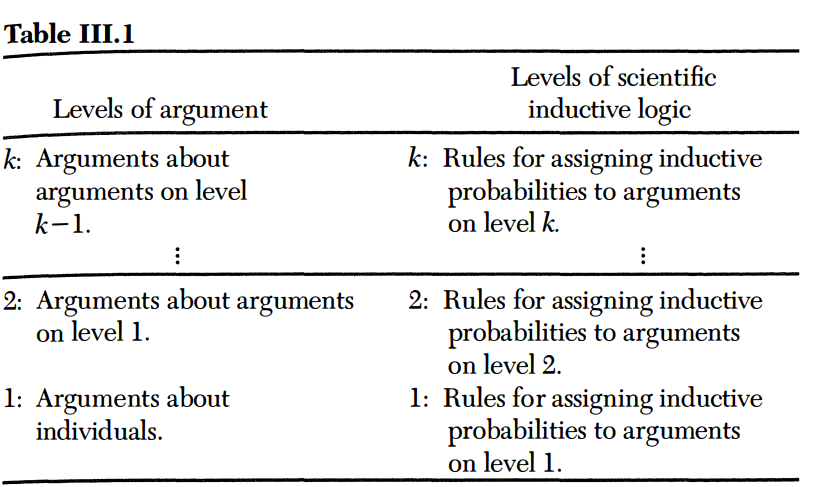
As the table shows, scientific inductive logic is seen not as a simple, homogeneous system but rather as a complex structure composed of an infinite number of strata of distinct sets of rules. The sets of rules on different levels are not, however, totally unrelated. The rules on each level presuppose, in some sense, that nature is uniform and that the future will resemble the past. If this were not the case, we would have no reason for calling the whole system of levels a system of scientific inductive logic.
We are now in a position to see how the system of levels of scientific induction is to be employed in the inductive justification of induction. In answer to the question, 'Why should we place our faith in the rules of level 1 of scientific inductive logic?" the proponent of the inductive justification of induction will advance an argument on level 2:
**Among arguments used to make predictions in the past, e-arguments on level 1 (which according to level 1 of scientific inductive logic are inductively strong) have given true conclusions most of the time.
With regard to the next prediction, an e-argument judged inductively strong by the rules of scientific inductive logic will yield a true conclusion.
The proponent will maintain that the premise of this argument is true, and if we ask why he thinks that this is an inductively strong argument, he will reply ,that the rules of level 2 of scientific inductive logic assign it a high inductive probability. If we now ask why we should put our faith in these rules, he will advance a similar argument on level 3, justify that argument by appeal to the rules of scientific inductive logic on level 3, justify those rules by an argument on level 4, and so on.
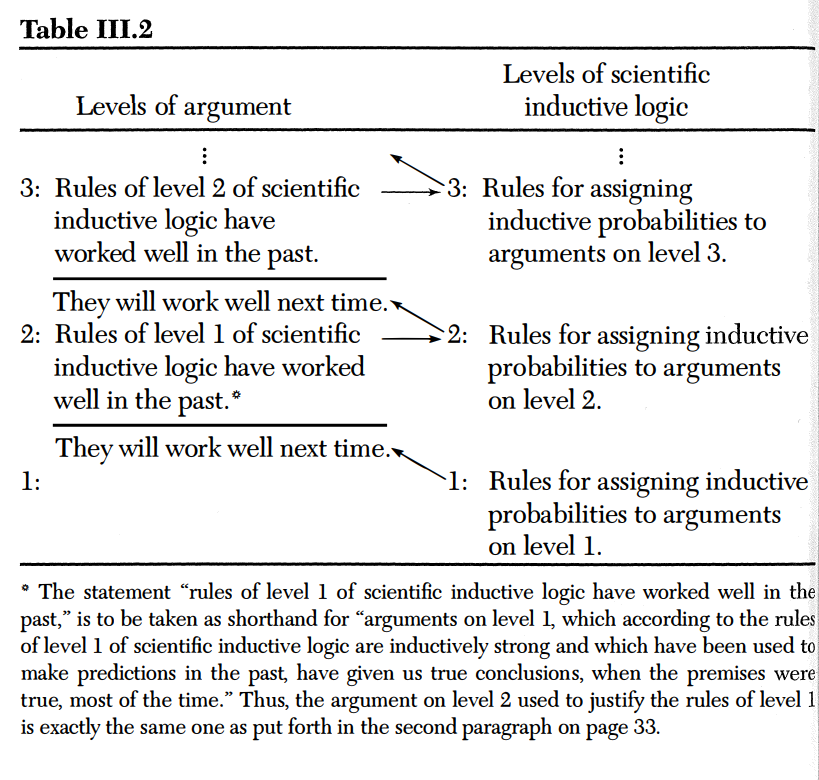
The inductive justification of induction is summarized in Table III.2. The arrows in the table show the order of justification. Thus, the rules of level 1 are justified by an argument on level 2, which is justified by the rules on level 2r which are justified by an argument on level 3, and so on.
Let us now see how it is that the proponent of the inductive justification of induction can plead not guilty to Hume's charge of begging the question; that is, of presupposing exactly what one is trying to prove. In justifying the rules of level 1, the proponent of the inductive justification of induction does not prersuppose that these rules will work the next time; in fact, he advances an argment (on level 2) to show that they will work next time.
Now it is true that the use of this argument presupposes that the rules of level 2 will work next time, But there is another argument waiting on level 3 to show that the rules of leveJ.f 2 will work. The use of that argument does not presuppose what it is trying to establish; it presupposes that the rules on level 3 will work. Thus, none of th I arguments used in the inductive justification of induction presuppose what they are trying to prove, and the inductive justification of induction does not technically beg the question.
Perhaps how these levels work can be made clearer by looking at a simple example. Suppose our only observations of the world have been of 100 jub-jub birds and they have all been purple. After observing 99 jub-jub birds, we advanced argument jj-99:
**We have seen 99 jub-jub birds and they were all purple.
The next jub-jub bird we see will be purple.
This argument was given high inductive probability by rules of level 1 of scientific inductive logic. We knew its premises to be true, and we took its conclusion as a prediction. The 100th jub-jub bird can thus be correctly described as purple-or as the color that makes the conclusion of argument jj-99 true-or as the color that results in a successful prediction by the rules of level 1 of scientific inductive logic. Let us also suppose that similar arguments had been advanced in the past: jj-98, jj-97, etc. Each of these arguments was an e-argument to which the rules of level 1 assigned high inductive probability. Thus, the observations of jub-jub birds 98 and 99, etc., are also observations of successful outcomes to predictions based on assignments of probabilities to e-arguments by rules of level 1. This gives rise to an argument on level 2:
e-arguments on level 1, which are assigned high inductive probability by rules of level 1, have had their conclusions predicted 98 times and all those predictions were successful.
Predicting the conclusion of the next e-argument on level 1 which is assigned high inductive probability will also lead to success.
This argument is assigned high inductive probability by rules of level 2. If the next jub-jub bird to be observed is purple, it makes this level 2 argument successful in addition to making the appropriate level 1 argument successful. A string of such successes gives rise to a similar argument on level 3 and so on, up the ladder, as indicated in Table IIl.2.
If someone were to object that what is wanted is a justification of scientific induction as a whole and that this has not been given, the proponent of the inductive justification of induction would reply that for every level of rules of scientific inductive logic he has a justification (on a higher level), and that certainly if every level of rules is justified, then the whole system is justified. He would maintain that it makes no sense to ask for a justification for the system over and above a justification for each of its parts. This position, it must be admitted, has a good deal of plausibility; a final evaluation of its merits, however, must await some further developments.
The position "held by the proponent of the inductive justification of induction contrasts with the position held by Hume in that it sets different requirements for the rational justification of a system of inductive logic. The following is implicit in the inductive justification of induction:
Rational Justification Suggestion II:
A system of inductive logic is rationally justified if, for every level (k) of rules of that system, there is an e-argument on the next highest level (k + 1) which:
**i. Is judged inductively strong by its own system's rules (these will be rules oflevel k + 1).
ii. Has as its conclusion the statement that the system's rules on the original level (k) will work well next time.
It is important to see that whether a system of induction meets these conditions depends not only on the system of induction itself but also on the facts, on the way that the world is. We can imagine a situation in which scientific induction would indeed not meet these conditions. Imagine a world which has been so chaotic that scientific induction on level 1 has not worked well; that is, suppose that the e-arguments on level 1, which according to the rules of level 1 of scientific inductive logic are inductively strong and which have been used to make predictions in the past, have given us false conclusions from true premises most of the time. In such a situation the inductive justification of induction could not be carried through. For although the argument on level 2 used to justify the rules of level 1 of scientific induction, that is:
**Rules of level 1 of scientific inductive logic have worked well in the past.
They will work well next time.
would still be judged inductively strong by the rules of level 2 of scientific inductive logic, its premise would not be true. Indeed, in the situation under consideration the following argument on level 2 would have a premise that was known to be true and would also be judged inductively strong by the rules of level 2 of scientific inductive logic:
Rules of level 1 of scientific inductive logic have not worked well in the past.
They will not work well next time.
Thus, we can conceive of situations in which level 2 of scientific induction, instead of justifying level 1 of scientific induction, would tell us that level 1 is unreliable.
We are not, in fact, in such a situation. Level 1 of scientific induction has served us quite well, and it is upon this fact that the inductive justification o f induction capitalizes. This is indeed an important fact, but it remains to be seen whether it is sufficient to rationally justify a system of scientific inductive logic.
The proponent of the inductive justification of scientific inductive logic has done us a service in distinguishing the various levels of induction. He has also made an important contribution by pointing out that there are possible situations in which the higher levels of scientific induction do not always support the lower levels and that we are, in fact, not in such a situation. But as a justification of the system of scientific induction his reasoning is not totally satisfactory. While he has not technically begged the question, he has come very close to it. Although he has an argument to justify every level of scientific induction, and although none of his arguments presuppose exactly what they are trying to prove, the justification of each level presupposes the correctness of the level above it. Lower levels are justified by higher levels, but always higher levels of scientific induction. No matter how far we go in the justifying process, we are always within the system of scientific induction.
Now, isn't this loading the dice? Couldn't someone with a completely different system of inductive logic execute the same maneuver? Couldn't he justify each level of his logic by appeal to higher levels of his logic? Indeed he could. Given the same factual situation in which the inductive justification of scientific induction is carried out, an entirely different system of inductive logic could also meet the conditions laid down under Rational Justification, Suggestion II. Let us take a closer look at such a contrasting system of inductive logic
We said that scientific induction assumes that, in some sense, nature is uniform and the future will be like the past. Some such assumption is to be found backing the rules on each level of scientific inductive logic. The assumptions are not exactly the same on each level; they must be different because we can imagine a situation in which scientific induction on level 2 would tell us that scientific induction on level 1 will not work well. Thus, different principles of the uniformity of nature are presupposed on different levels of scientific inductive logic. But although they are not exactly the same, they are similar; they are all principles of the uniformity of nature. Thus, each level of scientific inductive logic presupposes that, in some sense, nature is uniform and the future will be like the past. A system of inductive logic that would be diametrically opposed to scientific inductive logic would be one which presupposed on all levels that the future will not be like the past. We shall call this system a system of counterinductive logic.
Let us see how counterinductive logic would work on level 1. Scientific inductive logic, which assumes that the future will be like the past, would assign the following argument a high inductive probability:
Many jub-jub birds have been observed and they have all been purple.
The next jub-jub bird to be observed will be purple.
Counterinductive logic, which assumes that the future will not be like the past, would assign it a low inductive probability and would instead assign a high inductive probability to the following argument:
Many jub-jub birds have been observed and they have all been purple.
The next jub-jub bird to be observed will not be purple.
In general, counterinductive logic assigns low inductive probabilities to arguments that are assigned high inductive probabilities by scientific inductive logic, and high inductive probabilities to arguments that are assigned low inductive probabilities by scientific inductive logic.
Now suppose that a counterinductivist decided to give an inductive justification of counterinductive logic. The scientific inductivist would justify his rules of level 1 by the following level 2 argument:
Rules of level 1 of scientific induction have worked well in the past.
They will work well next time.
The counterinductivist, on the other hand, would justify his rules of level 1 by another kind of level 2 argument:
Rules of level 1 of counterinductive logic have not worked well in the past.
They will work well next time
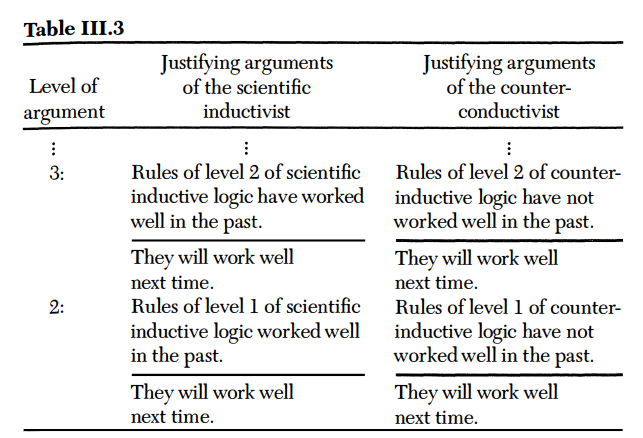
By the counterinductivisf s rules, this is an inductively strong argument, for on level 2 he also assumes that the future will be unlike the past. Thus, the counterinductivist is not at all bothered by the fact that his level 1 rules have been failures; indeed he takes this as evidence that they will be successful in the future. Granted his argument appears absurd to us, for we are all at heart scientific inductivists. But if the scientific inductivist is allowed to use his own rules on level 2 to justify his rules on level 1, how can we deny the same right to the counterinductivist? If asked to justify his rules on level 2, the counterinductivist will advance a similar argument on level 3, and so on. If an inductive justification of scientific inductive logic can be car ried through, then a parallel inductive justification of counterinductive l gic can be carried through. Table III.3 summarizes how this would be done.
The counterinductivist is, of course, a fictitious character. No one goes through life consistently adhering to the canons of counterinductive logic, although some of us do occasionally slip into counterinductive reasoning. The poor poker player who thinks that his luck is due to change because he has been losing so heavily is a prime example. But aside from a description of gamblers' rationalizations, counterinductive logic has little practical significance.
It does, however, have great theoretical significance. For what we have shown is that if scientific inductive logic meets the conditions laid down under Rational Justification, Suggestion II, so does counterinductive logic. This is sufficient to show that Suggestion II is inadequate as a definition for rational justification. A rational justification of a system of inductive logic must provide reasons for using that system rather than any other. Thus, if two inconsistent systems, scientific induction and counterinduction, can meet the conditions of Suggestion II, then Suggestion II cannot be an adequate definition of rational justification. The arguments examined in this section do show that scientific inductive logic meets the conditions of Suggestion II, but these arguments do not rationally justify scientific induction.
Let us say that any system of inductive logic that meets the conditions of Suggestion II is inductively coherent with the facts. It may be true that for a system of inductive logic to be rationally justified it must be inductively coherent with the facts; that is, that inductive coherence with the facts may be a necessary condition for rational justification. But the example of the counterinductivist shows conclusively that inductive coherence with the facts is not by itself sufficient to rationally justify a system of inductive logic. Consequently, the inductive justification of scientific inductive logic fails. We may summarize our discussion of the inductive justification of induction as follows:
- The proponent of the inductive justification of scientific induction points out that scientific inductive logic is inductively coherent with the facts.
- He claims that this is sufficient to rationally justify scientific inductive logic.
- But it is not sufficient since counterinductive logic is also inductively coherent with the facts.
- Nevertheless it is important and informative since we can imagine circumstances in which scientific inductive logic would not be inductively coherent with the facts.
- The proponent of the inductive justification of scientific induction has also succeeded in calling to our attention the fact that there are various levels of induction.
3.4 the pragmatic justification of induction
Remember that the traditional problem of induction can be formulated as a dilemma: If the reasoning we use to rationally justify scientific inductive logic is to have any strength at all it must be either deductively valid or inductively strong. But if we try to justify scientific inductive logic by means of a deductively valid argument with premises that are known to be true, our conclusion will be too weak. And if we try to use an inductively strong argument, we are reduced to begging the question. Whereas the proponent of the inductive justification of scientific induction attempts to go over the second horn of the dilemma, the proponent of the pragmatic justification of induction attacks the first horn; he attempts to justify scientific inductive logic by means of a deductively valid argument.
The pragmatic justification of induction was proposed by Herbert Feigl and elaborated by Hans Reichenbach, both founders of the logical empiricist movement. Reichenbach's pragmatic justification of induction is quite complicated, for it depends on what he believes are the details (at least the basic details) of scientific inductive logic. Thus, no one can fully understand Reichenbach's arguments until he has studied Reichenbach's definition of probability and the method he prescribes for discovering probabilities. We shall return to these questions later; at this point we will discuss a simplified version of the pragmatic justification of induction. This version is correct as far as it goes. Only bear in mind that there is more to be learned.
Reichenbach wishes to justify scientific inductive logic by a deductively valid argument. Yet he agrees with Hume that no deductive valid argument with premises that are known to be true can give us the conclusion that scientific induction will give us true conclusions most of the time. He agrees with Hurne that the conditions of Rational Justification, Suggestion I, cannot be met. Since he fully intends to rationally justify scientific inductive logic, the only path open to him is to argue that the conditions of Rational Justification, Suggestion I, need not be met in order to justify a system of inductive logic. He proceeds to advance his own suggestion as to what is required for rational justification and to attempt to justify scientific inductive logic in these terms.
If Hume's arguments are correct, there is no way of showing that scientific induction will give us true conclusions from true premises most of the time. But since Hume's arguments apply equally well to any system of inductive logic there is no way of showing that any competing system of inductive logic will give us true conclusions from true premises most of the time either. Thus, scientific inductive logic has the same status as all other systems of inductive logic in this matter. No other system of inductive logic can be demonstrated to be superior to scientific inductive logic in the sense of showing that it gives true conclusions from true premises more often than scientific inductive logic.
Reichenbach claims that although it is impossible to show that any inductive method will be successful, it can be shown that scientific induction will be successful, if any method of induction will be successful. In other words, it is possible that no inductive logic will guide us to e-arguments that give us true conclusions most of the time, but if any method will then scientific inductive logic will also. If this can be shown, then it would seem fair to say that scientific induction has been rationally justified. After all, we must make some sort of judgments, conscious or unconscious, as to the inductive strength of arguments if we are to live at all. We must base our decisions on our expectations of the future, and we base our expectations of the future on our knowledge of. the past and present. We are all gamblers, with the stakes being the success or failure of our plans of action. Life is an exploration of the unknown, and every human action presumes a wager with nature.
But if our decisions are a gamble and if no method is guaranteed to be successful, then it would seem rational to bet on that method which will be successful, if any method will. Suppose that you were forcibly taken into a locked room and told that whether or not you will be allowed to live depends on whether you win or lose a wager. The object of the wager is a box with red, blue, yellow, and orange lights on it. You know nothing about the construction of the box but are told that either all of the lights, some of them, or none of them will come on. You are to bet on one of the colors. If the colored light you choose comes on, you live; if not, you die. But before you make your choice you are also told that neither the blue, nor the yellow, nor the orange light can come on without the red light also coming on. If this is the only information you have, then you will surely bet on red. For although you have no guarantee that your bet on red will be successful (after all, all the lights might remain dark) you know that if any bet will be successful, a bet on red will be successful. Reichenbach claims that scientific inductive logic is in the same privileged position vis-a-vis other systems of inductive logic as is the red light vis-a-vis the other lights. This leads us to a new proposal as to what is required to rationally justify a system of inductive logic:
Rational Justification Suggestion III: A system of inductive logic is rationally justified if we can show that the e-arguments that it judges inductively strong will give us true conclusions most of the time, if e-arguments judged inductively strong by any method will. Reichenbach attempts to show that scientific inductive logic meets the conditions of Rational Justification, Suggestion III, by a deductively valid argument. The argument goes roughly like this: Either nature is uniform or it is not. If nature is uniform, scientific induction will be successful.
If nature is not uniform, then no method will be successful.
If any method of induction will be successful, then scientific induction will be successful.
There is no question that this argument is deductively valid, and the first and second premises are surely known to be true. But how do we know that the third premise is true? Couldn't there be some strange inductive method that would be successful even if nature were not uniform? How do we know that for any method to be successful nature must be uniform?
Reichenbach has a response ready for this challenge. Suppose that in a completely chaotic universe, some method, call it method X, were successful. Then there is still at least one outstanding uniformity in nature: the uniformity of method X's success. And scientific induction would discover that uniformity. That is, if method X is successful on the whole, if it gives us true predictions most of the time, then sooner or later the statement "Method X has been reliable in the past" will be true, and the following argument would be judged inductively strong by scientific inductive logic:
Method X has been reliable in the past.
Method X will be reliable in the future.
Thus, if method X is successful, scientific induction will also be successful in that it will discover method X's reliability, and, so to speak, license method X as a subsidiary method of prediction. This completes the proof that scientific induction will be successful if any method will. The job may appear to be done, but in fact there is a great deal more to be said. In order to analyze just what has been proved and what has not, we shall use the idea of levels of inductive logic, which was developed in the last section. When we talk about a method, we are really talking about a system of inductive logic, while glossing over the fact that a system of inductive logic is composed of distinct levels of rules. Let us now pay attention to this fact. Since a system of inductive logic is composed of distinct levels of rules, in order to justify that system we would have to justify each level of its rules. Thus, to justify scientific inductive logic we would have to justify level 1 rules of scientific inductive logic, level 2 rules of scientific inductive logic, level 3 rules of scientific inductive logic, and so on. Let us now pay attention to this fact. Since a system of inductive logic is composed of distinct levels of rules, in order to justify that system we would have to justify each level of its rules. Thus, to justify scientific inductive logic we would have to justify level 1 rules of scientific inductive logic, level 2 rules of scientific inductive logic, level 3 rules of scientific inductive logic, and so on.
1: Level 1 rules of scientific induction will be successful if level 1 rules of any system of inductive logic will be successful. 2: Level 2 rules of scientific induction will be successful if level 2 rules of any system of inductive logic will be successful. . . . k: Level k rules of scientific induction will be successful if level k rules of any system of inductive logic will be successful.
But if we look closely at the pragmatic justification of induction, we see that it does not establish this but rather something quite different. Suppose that system X of inductive logic is successful on level 1. That is, the arguments that it judges to be inductively strong give us true conclusions from true premises most of the time. Then sooner or later an argument on level 2 which is judged inductively strong by scientific inductive logic, that is:
Rules of level 1 of system X have been reliable in the past.
Rules of level 1 of system X will be reliable in the future.
will come to have a premise that is known to be true. If the rules on level 1 of. system X give true predictions most of the time, then sooner or later it will be true that they have given us true predictions most of the time in the past. And once we have this premise, scientific induction on level 2 leads us to the conclusion that they will be reliable in the future.
Thus, what has been shown is that if any system of inductive logic has successful rules on level 1, then scientific induction provides a justifying argument for these rules on level 2. Indeed, we can generalize this principle and say that if a system of inductive logic has successful rules on a given level, then scientific induction provides a justifying argument on the next highest level. More precisely, the pragmatist has demonstrated the following: If system X of inductive logic has rules on level k which pick out, as inductively strong arguments of level k, those which give true predictions most of the time, then there is an argument on level k + 1, which is judged inductively strong by the rules of level k + 1 of scientific inductive logic, which has as its conclusion the statement that the rules of system X on level k are reliable, and which has a premise that will sooner or later be known to be true.
Now this is quite different from showing that if any method works on any level then scientific induction will also work on that level, or even from showing that if any method works on level 1 then scientific induction will work on level 1. Instead what has been shown is that if any other method is generally successful on level 1 then scientific induction will have at least one notable success on level 2: it will eventually predict the continued success of that other method on level 1.
Although this is an interesting and important conclusion, it is not sufficient for the task at hand. Suppose we wish to choose a set of rules for level 1. In order to be in a position analogous to the wager about the box with the colored lights, we would have to know that scientific induction would be successful on level 1 if any method were successful on level 1. But we do not know this. For all we know, scientific induction might fail on level 1 and another method might be quite successful. If this were the case, scientific induction on level 2 would eventually tell us so, but this is quite a different matter.
In summary, the attempt at a pragmatic justification of induction has made us realize that a deductively valid justification of scientific induction would be acceptable if it could establish that: if any system of inductive logic has successful rules on a given level, then scientific inductive logic will have successful rules on that level. But the arguments advanced in the pragmatic justification fail to establish this conclusion. Instead, they show that if any system of inductive logic has successful rules on a given level, then scientific inductive logic will license a justifying argument for those rules on the next higher level.
Both the attempt at a pragmatic justification and the attempt at an inductive justification have failed to provide an absolute justification of scientific induction. Nevertheless, both of them have brought forth useful facts. For instance, the pragmatic justification of induction shows one clear advantage of scientific induction over counterinduction. The counterinductivist cannot prove that if any method is successful on level 1, counterinduction on level 2 will eventually predict its continued success. In fact some care is required to even give a logically consistent formulation of counterinduction as a general policy. It seems, then, that there is still room for constructive thought on the problem, and that we can learn much from previous attempts to solve it.
3.5 Summary
We have developed the traditional problem of induction and discussed several answers to it. We found that each position we discussed had a different set of standards for rational justification of a system of inductive logic.
I. Position: The original presentation of the traditional problem of induction. Standard for Rational Justification: A system of inductive logic is rationally justified if and only if it is shown that the e-arguments that it judges inductively strong yield true conclusions most of the time.
II. Position: The inductive justification of induction. Standard for Rational justification: A system of inductive logic is rationally justified if for every level (k) of rules of that system there is an e-argument on the next highest level (k + 1) which: i. Is judged inductively strong by its own system's rules. ii. Has as its conclusion the statement that the system's rules on the original level (k) will work well next time.
III. Position: The pragmatic justification of induction. Standard for Rational justification: A system of inductive logic is rationally justified if it is shown that the e-arguments that it judges inductively strong yield true conclusions most of the time, if e-arguments judged inductively strong by any method will.
The attempt at an inductive justification of scientific inductive logic taught us to recognize different levels of arguments and corresponding levels of inductive rules. It also showed that scientific inductive logic meets the standards for Rational Justification, Suggestion II. However, we saw that Suggestion II is really not a sense of rational justification at all, for both scientific inductive logic and counterinductive logic can meet its conditions. Thus, it cannot justify the choice of one over the other.
The attempt at a pragmatic justification of scientific inductive logic showed· us that Suggestion III, properly interpreted in terms of levels of induction, would be an acceptable sense of rational justification, although it would be a weaker sense than that proposed in Suggestion I. However, the pragmatic justification fails to demonstrate that scientific induction meets the conditions of Suggestion III. It seems that we cannot make more progress in justifying inductive logic until we make some progress in saying exactly what scientific inductive logic is. The puzzles to be discussed in the next chapter show that we have to be careful in specifying the nature of scientific inductive logic.