
2.5 Epistemic Probability
We have seen that the concept of inductive probability applies to arguments. The inductive probability of an argument is the probability that its conclusion is true given that its premises are true. Thus, the inductive probability of an argument is a measure of the strength of the evidence that the premises provide for the conclusion. It is correct to speak of the inductive probability of an argument, but incorrect to speak of the inductive probability of statements.
inductive probability papplies ot premises or conlucion but we can't apply the same thing to statments.
There is, however, some sense of probability in which it is intuitively acceptable to speak of the probability of a premise or conclusion. When we said that it is improbable that there is a 2000-year-old man in Cleveland, we were relying on some such intuitive sense of probability. There must then be a type of probability, other than inductive probability, that applies to statements rather than arguments.
Let us call this type of probability epistemic probability because the Greek stem episteme means knowledge, and the epistemic probability of a statement depends on just what our stock of relevant knowledge is. Thus, the epistemic probability of a statement can vary from person to person and from time to time, since different people have different stocks of knowledge at the same time and the same person has different stocks of knowledge at different times. For me, the epistemic probability that there is a 2000-year-old man now living in Cleveland is quite low, since I have certain background knowledge about the current normal life span of human beings. I feel safe in using this statement as an example of a statement whose epistemic probability is low because I feel safe in assuming that your stock of background knowledge is similar in the relevant respects and that for you its epistemic probability is also low.
It is easy to imagine a situation in which the background knowledge of two people would differ... For example, the epistemic probability that Pegasus will show in the third race may be different for a fan in the grandstand than for Pegasus' jockey, owing to the difference in their knowledge of the relevant factors involved.
It is also easy to see how the epistemic probability of a given statement cartchange over time for a particular person. The fund of knowledge that each oftus possesses is constantly in a state of flux.
It is important to see how upon the addition of new knowledge to previous body of knowledge the epistemic probability of a given statement could either increase or decrease . Suppose we are interested in the epistemic! probability of the statement that Mr. X is an Armenian and the only relevant) information we have is that Mr. X is an Oriental rug dealer in Allentown, Pa. ithat 90 percent of the Oriental rug dealers in the United States are Armenian,!1and that Allentown, Pa., is in the United States. On the basis of this stock ofirelevant knowledge, the epistemic probability of the statement is equal to the'!inductive probability of the following argument:
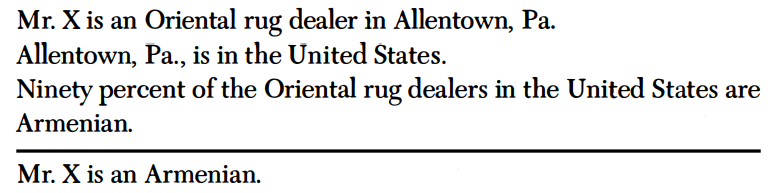 The inductive probability of this argument is quite high. If we are now givenlthe new information that although 90 percent of the Oriental rug dealers in0the United States are Armenian, only 2 percent of the Oriental rug dealers in!Allentown, Pa. , are Armenian, while 98 percent are Syrian, the epistemic! probability that Mr. X is Armenian decreases drastically, for it is now equal to:the inductive probability of the following argument:
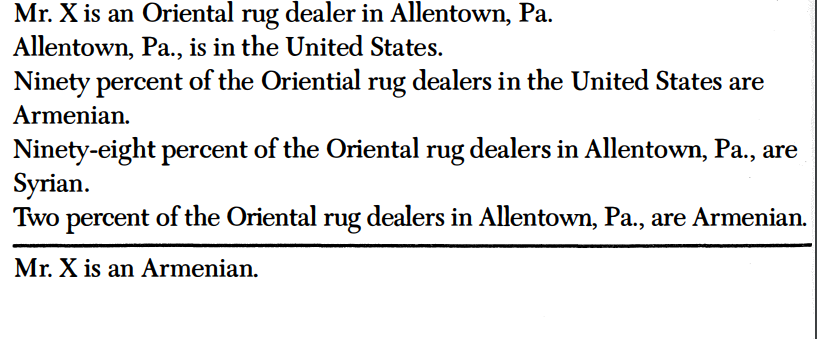 The inductive probability of this argument is quite low. ***Note that the decrease in the #epistemic_probability of the statement "Mr. X is an Armenian" results not from a change in the inductive probability of a given argument but from the fact that, upon the addition of new information, a different argument with more premises becomes relevant in assessing its epistemic probability.
Epistemic probabilities are important to us. They are the probabilities upon which we base our decisions. From a stock of knowledge we will arrive at the associated epistemic probability of a statement by the application of inductive logic. Exactly how inductive logic gets us epistemic probabilities from a stock of knowledge depends on how we characterize a stock of knowledge. Just what knowledge is; how we get it; what it is like once we have it; these are deep questions. At this stage, we will work within a simplified model of knowingthe Certainty Model.
The Certainty Model:
Suppose that our knowledge originates in observation; that observation makes particular sentences (observation reports) certain and that the probability of other sentences is attributable to the certainty of these. In such a situation we can identify our stock of knowledge with a list of sentences, those observation reports that have been rendered certain by observational experience.
It is then natural to evaluate the probability of a state- j ment by looking at an argument with all our stock of knowledge as premise and the statement in question as the conclusion. The inductive strength of that argument will determine the probability of the statement in question. In the certainty model, the relation between epistemic probability and inductive ' probability is quite simple:
Definition 5: The epistemic probability of a statement is the inductive probability of that argument which has the statement in question as its conclusion and whose premises consist of all of the observation reports which comprise our stock of knowledge.
The Certainty Model lives up to its name by assigning epistemic probability , of one to each observation report in our stock of knowledge. The certainty of observation reports may be something of an idealization- But it is a useful idealization, and we will adopt it for the present. Later in the course we will discuss some other models of observation.
11.6. PROBABILITY AND THE #PROBLEMS_OF_INDUCTIVE_LOGIC
Deductive logic, at least in its basic branches, is well-developed. The definitions of its basic concepts are precise, its rules are rigorously formulated, and the interrelations between the two are well understood. Such is not the case, however, with inductive logic. This is not to say that inductive logicians are wallowing in a sea of total ignorance; many things are known about inductive logic, but many problems still remain to be solved. We shall try to get an idea of just what the problems are, as well as what progress has been made toward their solution.
The logician, is not satisfied with an intuitive feeling for the meaning of key words and phrases. He wishes to analyze the concepts involved and arrive at precise, unambiguous definitions. Thus, one of the problems of inductive logic which remains outstanding is, what exactly is inductive probability?
This problem is intimately connected with two other problems: How is the inductive probability of an argument measured? And, what are the rules for constructing inductively strong arguments? Obviously we cannot develop an exact measure of inductive probability if we do not know precisely what it is.
And before we can devise rules for constructing inductively strong arguments, we must have ways of telling which arguments measure up to the required degree of inductive strength. Thus, the solution to the problem of providing a precise definition of inductive probability determines what solutions are available for the problems of determining the inductive probabilities of arguments and constructing systematic rules for generating inductively strong arguments.
Let us call a precise definition of inductive probability, together with the associated method of determining the inductive probability of arguments and rules for constructing inductively strong arguments, an inductive logic. Thus, different definitions of inductive probability give rise to different inductive logics.
We want a system that gives the result that most of the cases that we would intuitively classify as inductively strong arguments do indeed have a high inductive probability. We want a system that accords with scientific practice and common sense, but that is more precise, more clearly formulated, and more rigorous than they are; a system that codifies, explains, and refines our intuitive judgments. We shall call such a system of inductive logic a scientific inductive logic. The problem that we have been discussing can now be reformulated as the problem of constructing a scientific inductive logic.
The second major problem of inductive logic, and the one that has been more Widely discussed in the history of philosophy, is the problem of rationally justifying the use of a system of scientific inductive logic rather than some other system of inductive logic. After all, there are many different possible inductive logics...there are possible inductive logics which are diametrically opposed to scientific inductive logic, which are in total disagreement with scientific practice and common sense. Why ··.· should we not employ one of these systems rather than scientific induction?
Any adequate answer to this question must take into account the uses to which we put inductive logic (or, at present, the vague intuitions we use in place of a precise system of inductive logic). One of the most important uses of inductive logic is to frame our expectations of the future on the basis of our knowledge of the past and present. We must use our knowledge of the past and present as a guide to our expectations of the future; it is the only guide we have. But it is impossible to have a deductively valid argument whose premises contain factual information solely about the past and present and whose conclusion makes factual claims about the future. For the conclusion of a deductively valid argument makes no factual claim that is not already made by the premises. Thus, the gap separating the past and present from the future cannot be bridged in this way by deductively valid arguments, and if the arguments we use to bridge that gap are to have any strength whatsoever they must be inductively strong.
Let us look a little more closely, then, at the way in which inductive logic would be used to frame our expectations of the future. Suppose our plans depend critically on whether it will rain tomorrow. Then the reasonable thing to do, before we decide what course of action to take, is to ascertain the epistemic probability of the statement. "It will rain tomorrow." This we do by putting all the relevant information we now have into the premises of an argument whose conclusion is "It will rain tomorrow" and ascertaining the inductive probability of that argument. If the probability is high, we will have a strong expectation of rain and will make our plans on that basis. If the probability is near zero, we will be reasonably sure that it will not rain and act accordingly.
Now although it is doubtful tl1at anyone carries out the formal process outlined above when he plans for the future, it is hard to deny that, if we were to make our reasoning explicit, it would fall into this pattern. Thus, the making of rational decisions is dependent, via the concept of epistemic probability, on our inductive logic. The second main problem of inductive logic, then, leads us to the following question: How can we rationally justify the use of scientific inductive logic, rather than some other inductive logic, as an instrument for shaping our expectations of the future?
The two main problems of inductive logic are:
- The construction of a system of scientific inductive logic.
- The rational justification of the use of that system rather than some other system of inductive logic.
It would seem that the first problem must be solved before the second, since 11 we can hardly justify the use of a system of inductive logic before we know what it is. Nevertheless, I shall discuss the second problem first. It makes sense to do this because we can see why the second problem is such a problem without having to know all the details of scientific inductive logic. Furthermore, philosophers historically came to appreciate the difficulty of the second problem much earlier than they realized the full force of the first problem. This second problem, the #traditional_problem_of_induction, is discussed in the next chapter.