
The 2012 Summer Olympics badminton tournament provides an interesting case study of strategic manipulation. The tournament featured round-robin group play with a cut to a single-elimination quarterfinals bracket. Officials determined the seeding for the quarterfinals by the win/loss records during the round-robin matches. In the morning matches of the final day of round-robin play, the second-best team in the world lost. While their previous victories still ensured that the team would reach the quarterfinals, their defeat pushed them into the lower half of the seeding. This had an interesting impact on the afternoon matches. Teams who had already clinched a quarterfinal spot now had incentive to lose their remaining games. After all, a higher seeding meant a greater likelihood of facing the world’s second-best team earlier in the elimination rounds. Matches turned into contests to see who could lose most efficiently! To untangle the twisted logic at work here, consider the following game. Two players have to choose whether to try or fail.
The quality of any corresponding outcome is diagrammed in the game matrix below:
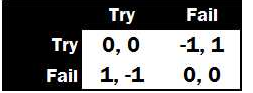 Ordinarily, we would expect trying to be a good thing and failing to be a bad thing. The reverse is true here. Each team most prefers failing while the other team tries; this ensures the team in question will lose, drop into the lower part of the quarterfinals bracket, and thus avoid the world’s second best team. The worst outcome for a team is for that team to try while the other team fails; this ensures that the original team wins the match but then must face a harder path through the single elimination bracket. If both try or both fail, then neither has an inherent strategic advantage. Like the prisoner’s dilemma, we can solve this game with strict dominance alone.