
First, consider two states considering whether to go to war . The military technology available to these countries gives the side that strikes first a large advantage in the fighting. In fact, the first-strike benefit is so great that each country would prefer attacking the other state even if its rival plays a peaceful strategy. However, because war destroys property and kills people, both prefer remaining at peace to simultaneously declaring war. Using these preferences, we can draw up the following matrix:
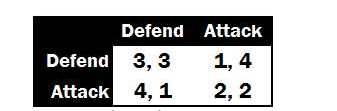
From this, we can see that the states most prefer attacking while the other one plays defensively. (This is due to the first-strike advantage.) Their next best outcome is to maintain the peace through mutual defensive strategies. After that, they prefer declaring war simultaneously. Each state’s worst outcome is to choose defense while the other side acts as the aggressor. We do not need to solve this game—we already have! This is the same game from the previous section, except we have exchanged the labels “quiet” with “defend” and “confess” with “attack.” Thus, we know that both states attack in this situation even though they both prefer the outcome. The first-strike advantages trap the states in a prisoner’s dilemma that leads to war.
states must simultaneously choose whether to develop a new military technology. Constructing weapons is expensive but provides greater security against rival states. We can draw up another matrix for this scenario:
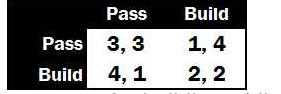 Here, the states most prefer building while the other state passes. Following that, they prefer the outcome to the outcome; the states maintain the same relative military strength in both these outcomes, but they do not waste money on weaponry if they both pass. The worst possible outcome is for the other side to build while the original side passes. Again, we already know the solution to this game. Both sides engage in the arms race and build.
Now consider international trade . Many countries place tariffs (a tax) on imported goods to protect domestic industries even though this leads to higher prices overall. We can use the prisoner’s dilemma to explain this phenomenon.
A country can levy a tariff against another country’s goods or opt for no taxes. The best outcome for a country is to tax imports while not having the other country tax its exports. This allows the domestic industries to have an advantage at home and be competitive abroad, and the country also earns revenue from the tax itself. Free trade is the next best outcome, as it allows the lowest prices for each country’s consumers. Mutual tariffs is the next best outcome, as they give each country an advantage at home but a disadvantage abroad; ultimately, this leads to higher prices than the free trade outcome. The worst possible outcome is to levy no taxes while the other country enforces a tariff, as domestic industries stand no chance against foreign rivals.
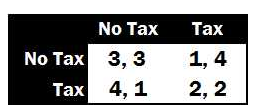
We know this is a prisoner’s dilemma and both sides will tariff each other’s goods: taxing strictly dominates not taxing in this setup.
Ads: another classic example of the prisoner’s dilemma
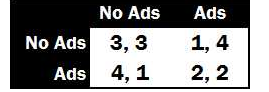 Thus, both sides advertise to preempt the other side’s campaign. The ads ultimately cancel each other out, and the firms end the game in a worse position than had they both not placed ads.
The Public Health Cigarette Smoking Act is a noteworthy application of the advertising game. In 1970, Richard Nixon signed the law, which removed cigarette ads from television. Tobacco companies actually benefited from this law in a perverse way—the law forced them to cooperating with each other. In terms of the game matrix, the law pushed them from the <2, 2> payoff to the mutually preferable <3, 3> payoff. The law simultaneously satisfied politicians, as it made targeting children more difficult for all tobacco companies.
These examples illustrate game theory’s ability to draw parallels between seemingly dissimilar situations. We have seen models of prisoner confession, wars, arms races, taxation, and advertisements. Despite the range of examples, each had an underlying prisoner’s dilemma mechanism. In this manner, game theory allows us to unify a wide-range of life decisions under a single, unified framework.